Each fall, Jews celebrate the holiday of Sukkot, named after the
“huts” the Jewish people lived in during their 40 years in the
wilderness. Sukkot begins on the night of the largest full moon of the
year, the harvest moon. This year it began at sundown on Friday, October
2, and runs through October 10. As a celebration of the year’s largest
harvest, Sukkot reminds us to give thanks. The American Pilgrims
understood this biblical significance of Sukkot, and made it the basis
for Thanksgiving.
Tradition calls us to “live” for a week in a sukkah (sukkot
is the plural form) — a hut, open to the sky, with some leaves for a
roof. (Eating meals there can qualify for “living,” especially during
inclement weather.) Living in a hut reminds us of our interdependence
with nature. Our buildings and vehicles are artificial barriers, which
insulate us from so many effects of nature. We succumb to an “edifice
complex.” They distract us from our constant interaction with nature,
inhibiting us from “smelling the roses.” They limit our awareness of the
impact we have on nature, so we don’t deal with pollution, conservation
of resources — dying species, sustainable development, diversity of
energy resources — global warming, or even adequate preparation for
“natural” disasters. Just ask the residents of New Orleans. As we become
more aware of interdependence, we accept our stewardship of nature.
Check Busted Halo for more information....
Showing posts with label Judaism. Show all posts
Thursday, September 19, 2013
Monday, January 28, 2013
New Year
Since our Christian faith finds it's beginnings in Judaism, I am always curious about it's customs.
I was surprised to find that last Friday (1/25/13) was Tu B'shevat, the New Year for the Trees. It has to do with Tithing of trees which produce fruit and nuts and counting their age...in recent years it has become a celebration of ecological awareness and trees are planted.
Who knew the ancient Israelites were in the forefront of conservation...
I was surprised to find that last Friday (1/25/13) was Tu B'shevat, the New Year for the Trees. It has to do with Tithing of trees which produce fruit and nuts and counting their age...in recent years it has become a celebration of ecological awareness and trees are planted.
Who knew the ancient Israelites were in the forefront of conservation...
Labels:
Judaism
Wednesday, December 12, 2012
Chanukah
(Hanukkah), the Festival of Lights, begins on the 25th day of
the Jewish month of Kislev, and lasts for eight days. On the secular
calendar, Chanukah generally falls out in December. It started this past Sunday.
Check here for more information about this major Jewish holiday...
and enjoy this...(see if you know what city he's in...)
Check here for more information about this major Jewish holiday...
and enjoy this...(see if you know what city he's in...)
Labels:
Judaism
Wednesday, December 21, 2011
Hanukkah!
The video below is an explanation of the Jewish celebration of Hanukkah (or Chanukah)...today is the first day.
from: www.g-dcast.com
Labels:
Jewish festivals,
Judaism
Thursday, October 13, 2011
Sukkot
Significance: Remembers the wandering in the dessert; also a harvest festival
Observances: Building and "dwelling" in a booth; waving branches and a fruit during services
Length: 7 days
...On the fifteenth day of this seventh month is the Festival of Sukkot, seven days for the L-RD. -Leviticus 23:34
The Festival of Sukkot begins on Tishri 15, the fifth day after Yom Kippur. It is quite a drastic transition, from one of the most solemn holidays in our year to one of the most joyous. Sukkot is so unreservedly joyful that it is commonly referred to in Jewish prayer and literature as Z'man Simchateinu Z'mn Simchateinu (in Hebrew), the Season of our Rejoicing.
Sukkot is the last of the Shalosh R'galim (three pilgrimage festivals). Like Passover and Shavu'ot, Sukkot has a dual significance: historical and agricultural. Historically, Sukkot commemorates the forty-year period during which the children of Israel were wandering in the desert, living in temporary shelters. Agriculturally, Sukkot is a harvest festival and is sometimes referred to as Chag Ha-Asif Chag Ha-Asif (in Hebrew), the Festival of Ingathering.
The word "Sukkot" means "booths," and refers to the temporary dwellings that we are commanded to live in during this holiday in memory of the period of wandering. The Hebrew pronunciation of Sukkot is "Sue COAT," but is often pronounced as in Yiddish, to rhyme with "BOOK us." The name of the holiday is frequently translated "Feast of Tabernacles," which, like many translations of Jewish terms, isn't very useful. This translation is particularly misleading, because the word "tabernacle" in the Bible refers to the portable Sanctuary in the desert, a precursor to the Temple, called in Hebrew "mishkan." The Hebrew word "sukkah" (plural: "sukkot") refers to the temporary booths that people lived in, not to the Tabernacle.
Sukkot lasts for seven days. The two days following the festival, Shemini Atzeret and Simchat Torah, are separate holidays but are related to Sukkot and are commonly thought of as part of Sukkot.
The festival of Sukkot is instituted in Leviticus 23:33 et seq. No work is permitted on the first and second days of the holiday. (See Extra Day of Holidays for an explanation of why the Bible says one day but we observe two). Work is permitted on the remaining days. These intermediate days on which work is permitted are referred to as Chol Ha-Mo'ed, as are the intermediate days of Passover.
A Sukkot greeting: Chag Sameach! (KHAHG sah-MEHY-ahkh): Which literally means Joyous Festival!
Observances: Building and "dwelling" in a booth; waving branches and a fruit during services
Length: 7 days
...On the fifteenth day of this seventh month is the Festival of Sukkot, seven days for the L-RD. -Leviticus 23:34
The Festival of Sukkot begins on Tishri 15, the fifth day after Yom Kippur. It is quite a drastic transition, from one of the most solemn holidays in our year to one of the most joyous. Sukkot is so unreservedly joyful that it is commonly referred to in Jewish prayer and literature as Z'man Simchateinu Z'mn Simchateinu (in Hebrew), the Season of our Rejoicing.
Sukkot is the last of the Shalosh R'galim (three pilgrimage festivals). Like Passover and Shavu'ot, Sukkot has a dual significance: historical and agricultural. Historically, Sukkot commemorates the forty-year period during which the children of Israel were wandering in the desert, living in temporary shelters. Agriculturally, Sukkot is a harvest festival and is sometimes referred to as Chag Ha-Asif Chag Ha-Asif (in Hebrew), the Festival of Ingathering.
The word "Sukkot" means "booths," and refers to the temporary dwellings that we are commanded to live in during this holiday in memory of the period of wandering. The Hebrew pronunciation of Sukkot is "Sue COAT," but is often pronounced as in Yiddish, to rhyme with "BOOK us." The name of the holiday is frequently translated "Feast of Tabernacles," which, like many translations of Jewish terms, isn't very useful. This translation is particularly misleading, because the word "tabernacle" in the Bible refers to the portable Sanctuary in the desert, a precursor to the Temple, called in Hebrew "mishkan." The Hebrew word "sukkah" (plural: "sukkot") refers to the temporary booths that people lived in, not to the Tabernacle.
Sukkot lasts for seven days. The two days following the festival, Shemini Atzeret and Simchat Torah, are separate holidays but are related to Sukkot and are commonly thought of as part of Sukkot.
The festival of Sukkot is instituted in Leviticus 23:33 et seq. No work is permitted on the first and second days of the holiday. (See Extra Day of Holidays for an explanation of why the Bible says one day but we observe two). Work is permitted on the remaining days. These intermediate days on which work is permitted are referred to as Chol Ha-Mo'ed, as are the intermediate days of Passover.
A Sukkot greeting: Chag Sameach! (KHAHG sah-MEHY-ahkh): Which literally means Joyous Festival!
Labels:
Judaism
Saturday, October 8, 2011
Yom Kippur
Yom Kippur, the Day of Atonement, observed this year from sundown on Friday night, October 7th until nightfall on October 8th, and is the Most Awesome Day in the Jewish calendar.
Concluding the “Ten Days of Repentance,” also known as the “Days of Awe,” Yom Kippur is a day where few Jews venture further than home and a house of worship. Expect that most Jews you know will forgo their usual weekend routines. Instead of holding tickets to movies or concerts Friday night, they will have tickets for seats at a Kol Nidrei Service.
Before Yom Kippur Jews seek out and reconcile with friends, colleagues, family members and even enemies. Yom Kippur is the time to forgive and move on. “If we cannot forgive others,” said the Hassidic Master Israel Ba’al Shem Tov, “how can we expect God to forgive us?”
Jewish tradition outlines three paths to help along this process of fixing our lives leading up to and during Yom Kippur:
Tzedakah (Charity) - The ethical imperative to contribute our resources to support the needy, our communal organizations, and to make the world a better place.
Teshuvah (Repentance)- Acknowledging our shortcomings, showing regret for what we did, and resolving to not make the same mistakes again, reconciles our relationship with God.
Tefillah (Prayer)- Opening our hearts, putting thoughts into words, we pray in the plural, asking for the good of all, not for our own personal needs.
Some perform the ritual of kapparot, where we symbolically transfer our sins to an object which is then donated to charity. Even if we gave tzedakah before Rosh Hashanah, now is the time to double-down, and give more. At home our dining tables are prepared with white linens and before sun sets we will light candles as if for a festive meal.
For the next 25 hours, adults refrain from food or drink. We wear simple shoes without leather, forgo bathing and intimacy, and don’t even watch the playoffs. We congregate in temples and synagogues around the world in the evening to hear Kol Nidrei, a moving prayer which begins a day-long dialogue with God.
Most Jews dress to show the solemnness of the day, wearing white prayer shawls and yarmulkas. The very pious wear a special garment called a kittel which reminds us of burial shrouds. The Ark is covered in white tapestry and all the Torahs are taken out and held around the dais.
We pray for many hours, confessing our mistakes to God and striking our chests over the sins we and our community have committed. We chant the moving verses of the Unetaneh Tokef:
“On Rosh Hashanah will be inscribed and on Yom Kippur will be sealed, how many will pass from the earth and how many will be created; who will live and who will die...who by water and who by fire...Who will rest and who will wander, who will live in harmony and who will be harried, who will enjoy tranquility and who will suffer, who will be impoverished and who will be enriched, who will be degraded and who will be exalted.”
A special prayer, Yizkor, is recited to remember our departed loved ones. We read aloud the Book of Jonah about a man who thought he could outrun God, and learn a lesson about compassion. Yom Kippur concludes with a final prayer called Neila, before the figurative Gates of Heaven close to our prayers. We shout out seven times our holiest prayer “Shema Yisrael” and sound one long blast of the Shofar.
There is also a majestic and universal message of Yom Kippur which is undoubtedly the basis of many self-improvement books: no matter what we have done wrong this past year - there is an opportunity to fix it. Each of the main elements of the external observance of the Holy Day refer to a deep spiritual message.
Fasting on Yom Kippur helps us put our spiritual life before our physical needs and wants. We prove to ourselves and to God that we are the masters of our own destiny. We realize that we are more than flesh and bones, we are also spiritual beings that need to be nurtured and nourished. Fasting also helps us empathize with those who do without enough food and water every day. Our day of self-denial and asceticism is by choice, whereas millions are forced to endure hunger every day.
Communal worship reminds us that our lives do not transpire in a vacuum. Rather, our actions and deeds affect each another and the whole world. Wearing white invokes the memory of the Holy Temple in Jerusalem, where the the High Priest in ancient days sought forgiveness for the Jewish nation 2000 years ago.
Just observing Yom Kippur cleanses our souls from the spiritual dirt that has accumulated and prevents us from enjoying each moment of life. Yom Kippur literally renews our lives and gives us a clean slate for the coming year. The mistakes, errors in judgement, and selfishness that got us in trouble last year, can be forgiven by humanity and God on Yom Kippur.
If only our credit scores could also be forgiven.
May the lessons of Yom Kippur inspire us to show compassion, forgiveness, and love to ourselves and each other, and renew our souls. (from Washington Post)
"Have an easy fast!"
Concluding the “Ten Days of Repentance,” also known as the “Days of Awe,” Yom Kippur is a day where few Jews venture further than home and a house of worship. Expect that most Jews you know will forgo their usual weekend routines. Instead of holding tickets to movies or concerts Friday night, they will have tickets for seats at a Kol Nidrei Service.
Before Yom Kippur Jews seek out and reconcile with friends, colleagues, family members and even enemies. Yom Kippur is the time to forgive and move on. “If we cannot forgive others,” said the Hassidic Master Israel Ba’al Shem Tov, “how can we expect God to forgive us?”
Jewish tradition outlines three paths to help along this process of fixing our lives leading up to and during Yom Kippur:
Tzedakah (Charity) - The ethical imperative to contribute our resources to support the needy, our communal organizations, and to make the world a better place.
Teshuvah (Repentance)- Acknowledging our shortcomings, showing regret for what we did, and resolving to not make the same mistakes again, reconciles our relationship with God.
Tefillah (Prayer)- Opening our hearts, putting thoughts into words, we pray in the plural, asking for the good of all, not for our own personal needs.
Some perform the ritual of kapparot, where we symbolically transfer our sins to an object which is then donated to charity. Even if we gave tzedakah before Rosh Hashanah, now is the time to double-down, and give more. At home our dining tables are prepared with white linens and before sun sets we will light candles as if for a festive meal.
For the next 25 hours, adults refrain from food or drink. We wear simple shoes without leather, forgo bathing and intimacy, and don’t even watch the playoffs. We congregate in temples and synagogues around the world in the evening to hear Kol Nidrei, a moving prayer which begins a day-long dialogue with God.
Most Jews dress to show the solemnness of the day, wearing white prayer shawls and yarmulkas. The very pious wear a special garment called a kittel which reminds us of burial shrouds. The Ark is covered in white tapestry and all the Torahs are taken out and held around the dais.
We pray for many hours, confessing our mistakes to God and striking our chests over the sins we and our community have committed. We chant the moving verses of the Unetaneh Tokef:
“On Rosh Hashanah will be inscribed and on Yom Kippur will be sealed, how many will pass from the earth and how many will be created; who will live and who will die...who by water and who by fire...Who will rest and who will wander, who will live in harmony and who will be harried, who will enjoy tranquility and who will suffer, who will be impoverished and who will be enriched, who will be degraded and who will be exalted.”
A special prayer, Yizkor, is recited to remember our departed loved ones. We read aloud the Book of Jonah about a man who thought he could outrun God, and learn a lesson about compassion. Yom Kippur concludes with a final prayer called Neila, before the figurative Gates of Heaven close to our prayers. We shout out seven times our holiest prayer “Shema Yisrael” and sound one long blast of the Shofar.
There is also a majestic and universal message of Yom Kippur which is undoubtedly the basis of many self-improvement books: no matter what we have done wrong this past year - there is an opportunity to fix it. Each of the main elements of the external observance of the Holy Day refer to a deep spiritual message.
Fasting on Yom Kippur helps us put our spiritual life before our physical needs and wants. We prove to ourselves and to God that we are the masters of our own destiny. We realize that we are more than flesh and bones, we are also spiritual beings that need to be nurtured and nourished. Fasting also helps us empathize with those who do without enough food and water every day. Our day of self-denial and asceticism is by choice, whereas millions are forced to endure hunger every day.
Communal worship reminds us that our lives do not transpire in a vacuum. Rather, our actions and deeds affect each another and the whole world. Wearing white invokes the memory of the Holy Temple in Jerusalem, where the the High Priest in ancient days sought forgiveness for the Jewish nation 2000 years ago.
Just observing Yom Kippur cleanses our souls from the spiritual dirt that has accumulated and prevents us from enjoying each moment of life. Yom Kippur literally renews our lives and gives us a clean slate for the coming year. The mistakes, errors in judgement, and selfishness that got us in trouble last year, can be forgiven by humanity and God on Yom Kippur.
If only our credit scores could also be forgiven.
May the lessons of Yom Kippur inspire us to show compassion, forgiveness, and love to ourselves and each other, and renew our souls. (from Washington Post)
"Have an easy fast!"
Labels:
Judaism
Wednesday, October 5, 2011
Shofar
Last week I posted on Rosh Hashanah and attached a recording of a Shofar being blown. To me it sounds ancient, holy...I have an overwhelming urge to take on a reverential pose...it is one sounds like God to me.
In an effort to explain why it affects me this way, here is more information from the Jewish Virtual Library:
A shofar is an instrument made from the horn of a ram or other kosher animal. It was used in ancient Israel to announce the New Moon (Rosh Chodesh) and call people together. It was also blown on Rosh Hashanah, marking the beginning of the New Year, signifying both need to wake up to the call to repentance, and in connection with the portion read on the second day of Rosh Hashanah, the Binding of Isaac (Genesis, chapter 22) in which Abraham sacrifices a ram in place of his son, Isaac.
Today, the shofar is featured most prominently in the Rosh Hashanah morning services. It is considered a commandment to hear the shofar blown.
There is a great deal of symbolism tied in with the legal requirements for what constitutes a proper shofar. The shofar of Rosh Hashanah, whose purpose it is to rouse the Divine in the listener, may not be constructed of an artificial instrument. It must be an instrument in its natural form and naturally hollow, through whom sound is produced by human breath, which God breathes into human beings. This pure, and natural sound, symbolizes the lives it calls Jews to lead. What is more, the most desirable shofar is the bent horn of a ram. The ram reminds one of Abraham's willing sacrifice of that which was most precious to him. The curve in the horn mirrors the contrition of the one who repents.
In the Talmud, we read: Rabbi Abbahu said:
Why do we sound the shofar? Because the Holy One, blessed be God, said: Blow me a ram's horn that I may remember to your credit the binding of Isaac, the son of Abraham, and I shall account it to you as a binding of yourselves before Me. The Torah tells us: Abraham look up and behold, he saw a ram caught in the thicket by its horns [Genesis 22:13]. This teaches us that the Holy One, blessed be God, showed our ancestor Abraham the ram tearing himself free from one thicket and becoming entangled in another. Said the Holy One, blessed be God, to Abraham: Thus are your children destined to be caught in iniquities and entangled in misfortunes, but in the end they will be redeemed by the horns of a ram. Therefore the prophet Zechariah said of the time of redemption: And the Lord shall be seen over them, and his arrow shall go forth like the lightning; and the Lord God shall blow the shofar, and shall move in stormy winds of the south [Zechariah 9:14]. [Rosh Hashanah 16a]
According to Leo Rosten, “The bend in the shofar is supposed to represent how a human heart, in true repentance, bends before the Lord. The ram's horn serves to remind the pious how Abraham, offering his son Isaac in sacrifice, was reprieved when God decided that Abraham could sacrifice a ram instead. The man who blows the shofar is required to be of blameless character and conspicuous devotion; he must blow blasts of different timbre, some deep, some high, some quavering.”
Sources: Rabbi Scheinerman's homepage; Rosten, Leo. The Joys of Yiddish. NY: Pocket Books, 1991.
In an effort to explain why it affects me this way, here is more information from the Jewish Virtual Library:
A shofar is an instrument made from the horn of a ram or other kosher animal. It was used in ancient Israel to announce the New Moon (Rosh Chodesh) and call people together. It was also blown on Rosh Hashanah, marking the beginning of the New Year, signifying both need to wake up to the call to repentance, and in connection with the portion read on the second day of Rosh Hashanah, the Binding of Isaac (Genesis, chapter 22) in which Abraham sacrifices a ram in place of his son, Isaac.
Today, the shofar is featured most prominently in the Rosh Hashanah morning services. It is considered a commandment to hear the shofar blown.
There is a great deal of symbolism tied in with the legal requirements for what constitutes a proper shofar. The shofar of Rosh Hashanah, whose purpose it is to rouse the Divine in the listener, may not be constructed of an artificial instrument. It must be an instrument in its natural form and naturally hollow, through whom sound is produced by human breath, which God breathes into human beings. This pure, and natural sound, symbolizes the lives it calls Jews to lead. What is more, the most desirable shofar is the bent horn of a ram. The ram reminds one of Abraham's willing sacrifice of that which was most precious to him. The curve in the horn mirrors the contrition of the one who repents.
In the Talmud, we read: Rabbi Abbahu said:
Why do we sound the shofar? Because the Holy One, blessed be God, said: Blow me a ram's horn that I may remember to your credit the binding of Isaac, the son of Abraham, and I shall account it to you as a binding of yourselves before Me. The Torah tells us: Abraham look up and behold, he saw a ram caught in the thicket by its horns [Genesis 22:13]. This teaches us that the Holy One, blessed be God, showed our ancestor Abraham the ram tearing himself free from one thicket and becoming entangled in another. Said the Holy One, blessed be God, to Abraham: Thus are your children destined to be caught in iniquities and entangled in misfortunes, but in the end they will be redeemed by the horns of a ram. Therefore the prophet Zechariah said of the time of redemption: And the Lord shall be seen over them, and his arrow shall go forth like the lightning; and the Lord God shall blow the shofar, and shall move in stormy winds of the south [Zechariah 9:14]. [Rosh Hashanah 16a]
According to Leo Rosten, “The bend in the shofar is supposed to represent how a human heart, in true repentance, bends before the Lord. The ram's horn serves to remind the pious how Abraham, offering his son Isaac in sacrifice, was reprieved when God decided that Abraham could sacrifice a ram instead. The man who blows the shofar is required to be of blameless character and conspicuous devotion; he must blow blasts of different timbre, some deep, some high, some quavering.”
Sources: Rabbi Scheinerman's homepage; Rosten, Leo. The Joys of Yiddish. NY: Pocket Books, 1991.
Labels:
Judaism
Thursday, September 29, 2011
Today is Rosh Hashanah
...In the seventh month, on the first of the month, there shall be a sabbath for you, a remembrance with shofar blasts, a holy convocation. -Leviticus 16:24
Significance: New Year
Observances: Sounding the shofar (ram's horn trumpet)
Length: 2 Days (Some: 1 Day)
Customs: Dipping apples in honey; Casting off "sins" into a river
Greeting: L'shanah tovah! (For a good year!)
The name "Rosh Hashanah" is not used in the Bible to discuss this holiday. The Bible refers to the holiday as Yom Ha-Zikkaron (the day of remembrance) or Yom Teruah (the day of the sounding of the shofar). The holiday is instituted in Leviticus 23:24-25.
The shofar is a ram's horn which is blown somewhat like a trumpet. One of the most important observances of this holiday is hearing the sounding of the shofar in the synagogue. A total of 100 notes are sounded each day. There are four different types of shofar notes: tekiah, a 3 second sustained note; shevarim, three 1-second notes rising in tone, teruah, a series of short, staccato notes extending over a period of about 3 seconds; and tekiah gedolah (literally, "big tekiah"), the final blast in a set, which lasts (I think) 10 seconds minimum. The Bible gives no specific reason for this practice. One that has been suggested is that the shofar's sound is a call to repentance. The shofar is not blown if the holiday falls on Shabbat.
No work is permitted on Rosh Hashanah. Much of the day is spent in synagogue, where the regular daily liturgy is somewhat expanded. In fact, there is a special prayerbook called the machzor used for Rosh Hashanah and Yom Kippur because of the extensive liturgical changes for these holidays.
Another popular observance during this holiday is eating apples dipped in honey, a symbol of our wish for a sweet new year. This was the second Jewish religious practice I was ever exposed to (the first one: lighting Chanukkah candles), and I highly recommend it. It's yummy. We also dip bread in honey (instead of the usual practice of sprinkling salt on it) at this time of year for the same reason.
Another popular practice of the holiday is Tashlikh ("casting off"). We walk to flowing water, such as a creek or river, on the afternoon of the first day and empty our pockets into the river, symbolically casting off our sins. Small pieces of bread are commonly put in the pocket to cast off. This practice is not discussed in the Bible, but is a long-standing custom. Tashlikh is normally observed on the afternoon of the first day, before afternoon services. When the first day occurs on Shabbat, many synagogues observe Tashlikh on Sunday afternoon, to avoid carrying (the bread) on Shabbat.
Religious services for the holiday focus on the concept of G-d's sovereignty.
Days of Awe
The ten days starting with Rosh Hashanah and ending with Yom Kippur are commonly known as the Days of Awe (Yamim Noraim) or the Days of Repentance. This is a time for serious introspection, a time to consider the sins of the previous year and repent before Yom Kippur.
One of the ongoing themes of the Days of Awe is the concept that G-d has "books" that he writes our names in, writing down who will live and who will die, who will have a good life and who will have a bad life, for the next year. These books are written in on Rosh Hashanah, but our actions during the Days of Awe can alter G-d's decree. The actions that change the decree are "teshuvah, tefilah (prayer) and tzedakah (righteousness)," repentance, prayer, good deeds (usually, charity). These "books" are sealed on Yom Kippur. This concept of writing in books is the source of the common greeting during this time is "May you be inscribed and sealed for a good year."
Significance: New Year
Observances: Sounding the shofar (ram's horn trumpet)
Length: 2 Days (Some: 1 Day)
Customs: Dipping apples in honey; Casting off "sins" into a river
Greeting: L'shanah tovah! (For a good year!)
The name "Rosh Hashanah" is not used in the Bible to discuss this holiday. The Bible refers to the holiday as Yom Ha-Zikkaron (the day of remembrance) or Yom Teruah (the day of the sounding of the shofar). The holiday is instituted in Leviticus 23:24-25.
The shofar is a ram's horn which is blown somewhat like a trumpet. One of the most important observances of this holiday is hearing the sounding of the shofar in the synagogue. A total of 100 notes are sounded each day. There are four different types of shofar notes: tekiah, a 3 second sustained note; shevarim, three 1-second notes rising in tone, teruah, a series of short, staccato notes extending over a period of about 3 seconds; and tekiah gedolah (literally, "big tekiah"), the final blast in a set, which lasts (I think) 10 seconds minimum. The Bible gives no specific reason for this practice. One that has been suggested is that the shofar's sound is a call to repentance. The shofar is not blown if the holiday falls on Shabbat.
No work is permitted on Rosh Hashanah. Much of the day is spent in synagogue, where the regular daily liturgy is somewhat expanded. In fact, there is a special prayerbook called the machzor used for Rosh Hashanah and Yom Kippur because of the extensive liturgical changes for these holidays.
Another popular observance during this holiday is eating apples dipped in honey, a symbol of our wish for a sweet new year. This was the second Jewish religious practice I was ever exposed to (the first one: lighting Chanukkah candles), and I highly recommend it. It's yummy. We also dip bread in honey (instead of the usual practice of sprinkling salt on it) at this time of year for the same reason.
Another popular practice of the holiday is Tashlikh ("casting off"). We walk to flowing water, such as a creek or river, on the afternoon of the first day and empty our pockets into the river, symbolically casting off our sins. Small pieces of bread are commonly put in the pocket to cast off. This practice is not discussed in the Bible, but is a long-standing custom. Tashlikh is normally observed on the afternoon of the first day, before afternoon services. When the first day occurs on Shabbat, many synagogues observe Tashlikh on Sunday afternoon, to avoid carrying (the bread) on Shabbat.
Religious services for the holiday focus on the concept of G-d's sovereignty.
Days of Awe
The ten days starting with Rosh Hashanah and ending with Yom Kippur are commonly known as the Days of Awe (Yamim Noraim) or the Days of Repentance. This is a time for serious introspection, a time to consider the sins of the previous year and repent before Yom Kippur.
One of the ongoing themes of the Days of Awe is the concept that G-d has "books" that he writes our names in, writing down who will live and who will die, who will have a good life and who will have a bad life, for the next year. These books are written in on Rosh Hashanah, but our actions during the Days of Awe can alter G-d's decree. The actions that change the decree are "teshuvah, tefilah (prayer) and tzedakah (righteousness)," repentance, prayer, good deeds (usually, charity). These "books" are sealed on Yom Kippur. This concept of writing in books is the source of the common greeting during this time is "May you be inscribed and sealed for a good year."
Labels:
Judaism
Sunday, August 7, 2011
Friday, August 5, 2011
Thursday, December 2, 2010
Hanukkah

From the Hebrew word for "dedication" or "consecration", Hanukkah marks the re- dedication of the Temple in Jerusalem (Second Temple) after its desecration by the forces of the King of Syria Antiochus IV Epiphanes and commemorates the "miracle of the container of oil". According to the Talmud, at the re-dedication following the victory of the Maccabees over the Seleucid Empire, there was only enough consecrated olive oil to fuel the eternal flame in the Temple for one day. Miraculously, the oil burned for eight days, which was the length of time it took to press, prepare and consecrate fresh olive oil.
The festival is observed by the kindling of the lights of a unique candelabrum, the nine-branched Menorah, one additional light on each night of the holiday, progressing to eight on the final night.
On all eight days of Hanukkah two special blessings are said before the kindled menorah. On the first day of Hanukkah, a third is added to recognize the beginning of the Hanukkah season.
First Blessing
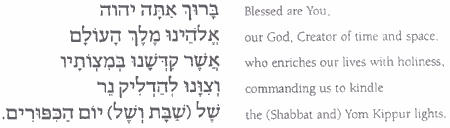
Baruch ata Adonai elohanu melech ha olam, asher kiddishanu b'mitzvotav v'tzivanu l'hadlik ner shel Hanukkah. (Blessed are you our God, Ruler of the world, who makes us holy through your mitzvoth, and commands us to kindle the Hanukkah lights.)
Second Blessing:
Baruch ata Adonai elohanu melech ha olam, she asa nisim l'avoteinu, bayamim ha-hem, bazman ha zeh. (Blessed are you our God, Ruler of the world, who worked miracles for our ancestors in days long ago at this season).
Third Blessing:
Baruch ata Adonai, elohanu melech ha olam, sheheheyanu, v'kiyimanu, v'higiyanu, lazman ha zeh. (Blessed are you our God, Ruler of the world, who has given us life, sustained us, and has brought us to this season.)
To our Jewish Brethern, Happy Hanukkah!
Labels:
Judaism
Monday, September 28, 2009
Yom Kippur
Today, September 28, 2009 is Yom Kippur, the Jewish Day of Atonement. This is the holiest day on the Jewish calendar and is all about repentance and atonement. The following is a prayer used today...
Normally this would be sung by a male Cantor, but this version is a little more modern...hauntingly beautiful!
AVINU MALKEINU אבינו מלכנו
Our Father, our King, we have sinned before You.
Our Father, our King, we have no King but You.
Our Father, our King, deal [kindly] with us for Your Name's sake.
Our Father, our King, bless us with a good year.
Our Father, our King, nullify all harsh decrees upon us.
Our Father, our King, nullify the designs of those who hate us.
Our Father, our King, thwart the counsel of our enemies.
Our Father, our King, exterminate every foe and adversary from upon us.
Our Father, our King, seal the mouths of our adversaries and accusers.
Our Father, our King, exterminate pestilence, sword, famine, captivity, destruction, iniquity and eradication from the members of Your covenant.
Our Father, our King, withhold the plague from Your heritage.
Our Father, our King, forgive and pardon all our iniquities.
Our Father, our King, wipe away and remove our willful sins and errors from Your sight.
Our Father, our King, erase through Your abundant compassion all record of our guilt.
Our Father, our King, return us to You in perfect repentance.
Our Father, our King, send complete recovery to the sick of Your people.
Our Father, our King, tear up the evil decree of our verdict.
Our Father, our King, recall us with a favorable memory before You.
Our Father, our King, make salvation sprout for us soon.
Our Father, our King, raise high the pride of Israel, Your people.
Our Father, our King, raise high the pride of Your anointed.
Our Father, our King, fill our hands from Your blessings.
Our Father, our King, fill our storehouses with abundance.
Our Father, our King, hear our voice, pity and be compassionate to us.
Our Father, our King, accept - with compassion and favor - our prayer.
Our Father, our King, open the gates of heaven to our prayer.
Our Father, our King, remember that we are but dust.
Our Father, our King, please do not turn us from You empty-handed.
Our Father, our King, may this moment be a moment of compassion and a time of favor before You.
Our Father, our King, take pity upon us, and upon our children and our infants.
Our Father, our King, act for the sake of those who were murdered for Your Set-Apart Name.
Our Father, our King, act for the sake of those who were slaughtered for Your Oneness.
Our Father, our King, act for the sake of those who went into fire and water for the
sanctification of Your Name.
Our Father, our King, avenge before our eyes the spilled blood of Your servants.
Our Father, our King, act for Your sake if not for our sake.
Our Father, our King, act for the sake of Your abundant compassion.
Our Father, our King, act for the sake of Your great, mighty, and awesome Name
that is proclaimed upon us.
Our Father, our King, be gracious with us and answer us, though we have no worthy deeds; treat us with charity and kindness, and save us.
Transliteration:
Avinu Malkeinu, hatanu l'phanecha
Avinu Malkeinu, ain lanu melech eleh attah.
Avinu Malkeinu, asei emanu l'ma'an sh'mecha
Avinu Malkeinu, barach aleinu shana tovah.
Avinu Malkeinu, batal mei'aleinu kal g'zayrot kashot.
Avinu Malkeinu,
Avinu Malkeinu chaneinu va'anaynu, ki ain banu ma'a'sim,
Asei im'manu tz'dakah va'chesed, v'ho'shi'ay'nu
Labels:
Judaism
Subscribe to:
Posts (Atom)